Restorative Dentistry
Comfortable, natural-looking tooth replacement built around your bite, your face, and the way you actually live each day.
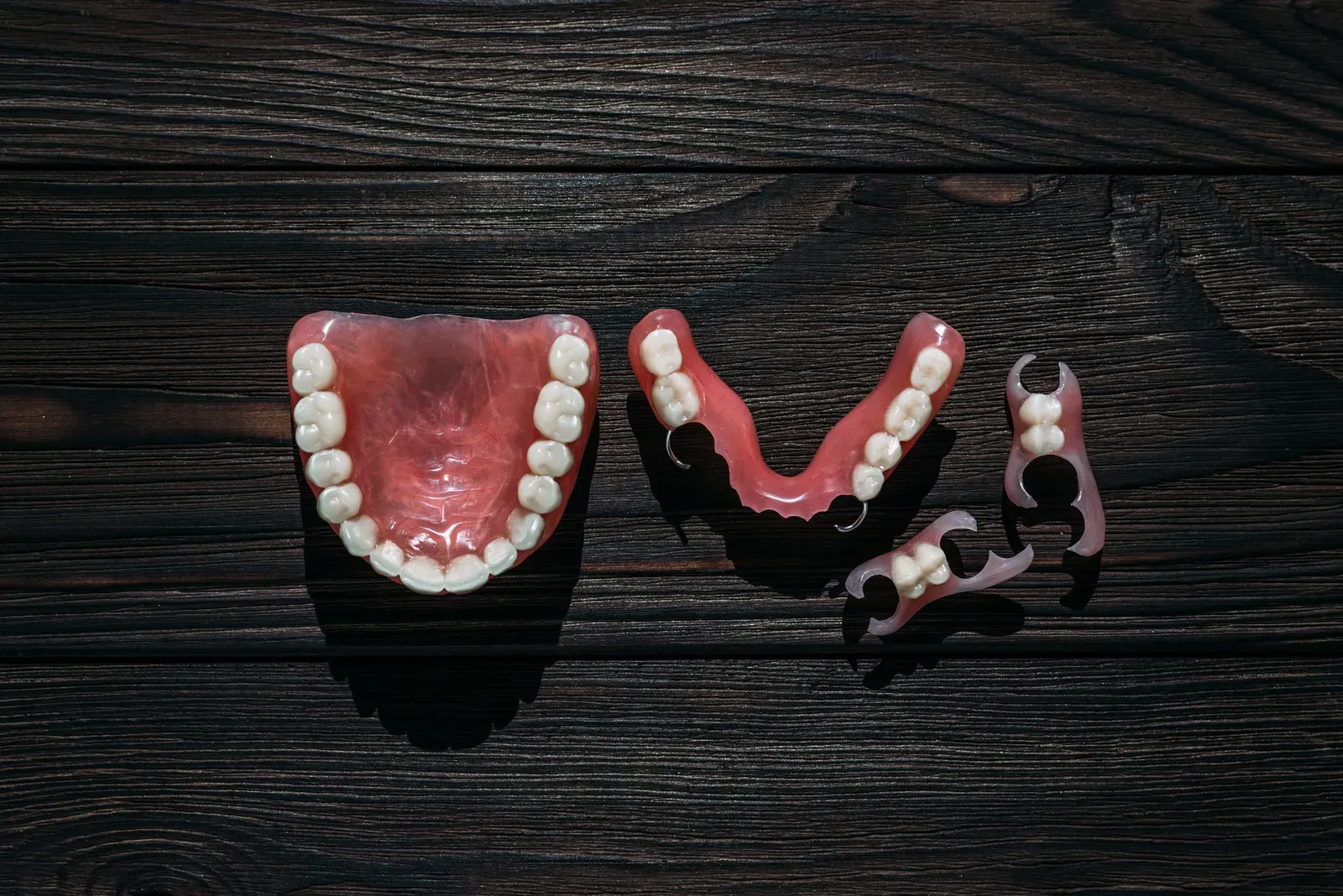
Losing one tooth or several changes more than your smile. It changes how food feels in your mouth, how your words come out, and how your jawbone and facial muscles are supported over time. At Premier Dental Studio of Katy, we build full and partial dentures that address all of that, not just the gap left behind. As part of our broader restorative dentistry program, dentures and partials give patients a dependable, affordable path back to confident chewing, clear speech, and a smile that still looks like their own.
Many patients come to us after years of avoiding certain foods, covering their mouth when they laugh, or noticing their face has started to look sunken near the jawline. These are common, understandable consequences of missing teeth, and they tend to get more pronounced the longer tooth loss goes unaddressed. Our team takes time to understand your specific situation, whether you need a full upper and lower set, a single removable partial to fill a gap between natural teeth, or an implant-supported denture for added stability.
Our clinical philosophy centers on fit first. A denture that looks good but shifts when you eat or speak does more harm to your confidence than good. That is why every denture and partial we fabricate goes through careful bite measurement, jaw relationship recording, and in-mouth adjustment before it ever leaves our Katy office as a finished appliance.
Tooth loss shows up differently for every patient, depending on how many teeth are missing, where they are located, and how long the gap has existed. Reviewing the signs below can help you decide whether it is time to schedule an evaluation.
A thorough clinical exam matters here because the right appliance depends on exactly how many teeth remain, their condition, and the shape of your jawbone. Guessing at a solution, or ordering a denture without proper measurements, is how patients end up with appliances that never truly feel right.
Tooth loss rarely happens for just one reason. Most patients we see have a combination of factors that built up gradually before reaching the point of needing a removable or implant-supported appliance.
Cavities that reach deep into the tooth structure without treatment often progress to the point where extraction is the only remaining option.
Gum disease breaks down the bone and ligament structures that hold teeth in place, eventually causing teeth to loosen and fail.
Sports accidents, falls, or other facial trauma can fracture or knock out teeth beyond the point of repair, requiring replacement.
Old fillings, crowns, and bridges eventually wear out, and when the underlying tooth cannot support another repair, extraction often follows.
Some patients are born with naturally weaker enamel, missing teeth, or crowded arches that make them more prone to early tooth loss.
Once a tooth is removed, the jawbone beneath it begins to resorb, which can make the fit of a delayed denture more challenging over time.
Conditions such as diabetes and dry mouth from certain medications increase the risk of decay and gum disease, accelerating tooth loss.
Every denture or partial we deliver is built in stages, with multiple checkpoints to confirm fit, bite, and appearance before the final appliance is complete.
We start by talking through your concerns, your goals for how your smile looks and functions, and any history with previous dentures or dental work.
Digital X-rays and an in-depth oral exam allow us to assess remaining teeth, bone structure, and gum health to determine the best appliance design.
We take precise impressions and bite measurements, then recommend full dentures, removable partials, or implant-supported options tailored to your mouth.
Before your final appliance is complete, you will try a wax or trial version so we can confirm shade, shape, and bite alignment feel natural before finishing.
We schedule follow-up visits to fine-tune the fit as your mouth adjusts, and we remain available for relines or repairs as your needs change over the years.
A well-made denture or partial does more than fill a gap in your smile. It restores function you may have gradually given up without fully realizing it.
You can expand your diet back to foods you may have been avoiding, which supports better nutrition and overall digestive comfort.
Replacing missing teeth restores the structures your tongue and lips rely on to form sounds accurately, so conversations feel effortless again.
A denture or partial helps fill out your cheeks and lips, reducing the sunken appearance that often follows extensive tooth loss.
Patients consistently tell us they smile and laugh more freely once their new teeth feel secure and look natural in everyday settings.
Partials hold your natural teeth in their correct positions, preventing the drifting and bite problems that can follow untreated gaps.
With proper care, dentures and partials provide years of reliable function, and relines keep them fitting comfortably as your mouth changes.
Choosing between a full denture, a removable partial, and an implant-supported appliance comes down to how many teeth remain, the condition of your jawbone, and your personal priorities for stability. Full dentures replace an entire arch of teeth and rest directly on the gum ridge, while partial dentures use clasps or precision attachments to connect to your remaining natural teeth, filling gaps without disturbing what is still healthy.
Implant-supported dentures take stability a step further by anchoring the appliance to a small number of strategically placed implants. This option significantly reduces movement during chewing and speaking, and it can help slow the bone loss that naturally occurs after tooth extraction. It is not the right fit for everyone, particularly patients with certain bone density concerns or health conditions, which is why a thorough evaluation always comes before any recommendation.
We walk you through the realistic trade-offs of each option in plain language, including cost, maintenance, and expected adjustment period, so you can make a decision that fits your lifestyle and budget rather than feeling pressured into the most expensive path.
Good daily habits extend the life of your appliance and keep your remaining gum tissue healthy. These simple routines make a real difference.
Brush your denture every day with a soft brush and a non-abrasive cleanser to remove plaque and food debris before it hardens.
Most removable dentures need moisture to maintain their shape, so soak them in water or a denture solution rather than letting them dry out.
Clean your denture over a folded towel or a sink filled with water to cushion it from an accidental drop, since these appliances can crack.
Rinsing after eating removes loose food particles and reduces the chance of irritation underneath the appliance.
Brush natural teeth, gums, and your tongue daily, since healthy tissue underneath a partial is just as important as the appliance itself.
Routine visits let us check fit, catch early irritation, and adjust the appliance before small issues turn into bigger discomfort.
These habits go a long way toward comfort and longevity, but they are not a substitute for professional evaluation. If your denture feels loose, causes sore spots, or has visible cracks, it is time to let our team take a look.
"I waited years before finally getting partials because I thought it would feel strange. The team here walked me through every step, adjusted the fit twice until it felt completely natural, and I finally smile without thinking about it."
Answers to the questions we hear most often from patients in Cinco Ranch considering dentures or partials.
Schedule your visit today and experience boutique, personalized dental care designed around you.

 6940 Katy-Gaston Rd Ste 200, Katy, TX 77494
 (281) 271-5100
